Why Manual Distribution Route Planning Hits Its Limits
Manual planning in B2B operations hits its limits as operational complexity grows. It simply cannot process real-time data, multiple constraints, and rapid changes at meaningful scale. From my experience supporting distribution organizations, the real goal of such a transition is not only savings. It is control, oversight, and transparency over field processes that have become too complex for one person to manage in their head.
Where Human Planning Reaches Its Limits
Manual planning works reasonably when the distribution map is stable, the stop count is low, and the workday barely changes after the first plan is built. A human planner does pick up operational nuance, but cannot recalculate hundreds of route combinations every time a driver is delayed, an extra order comes in, or warehouse release slips by half an hour.
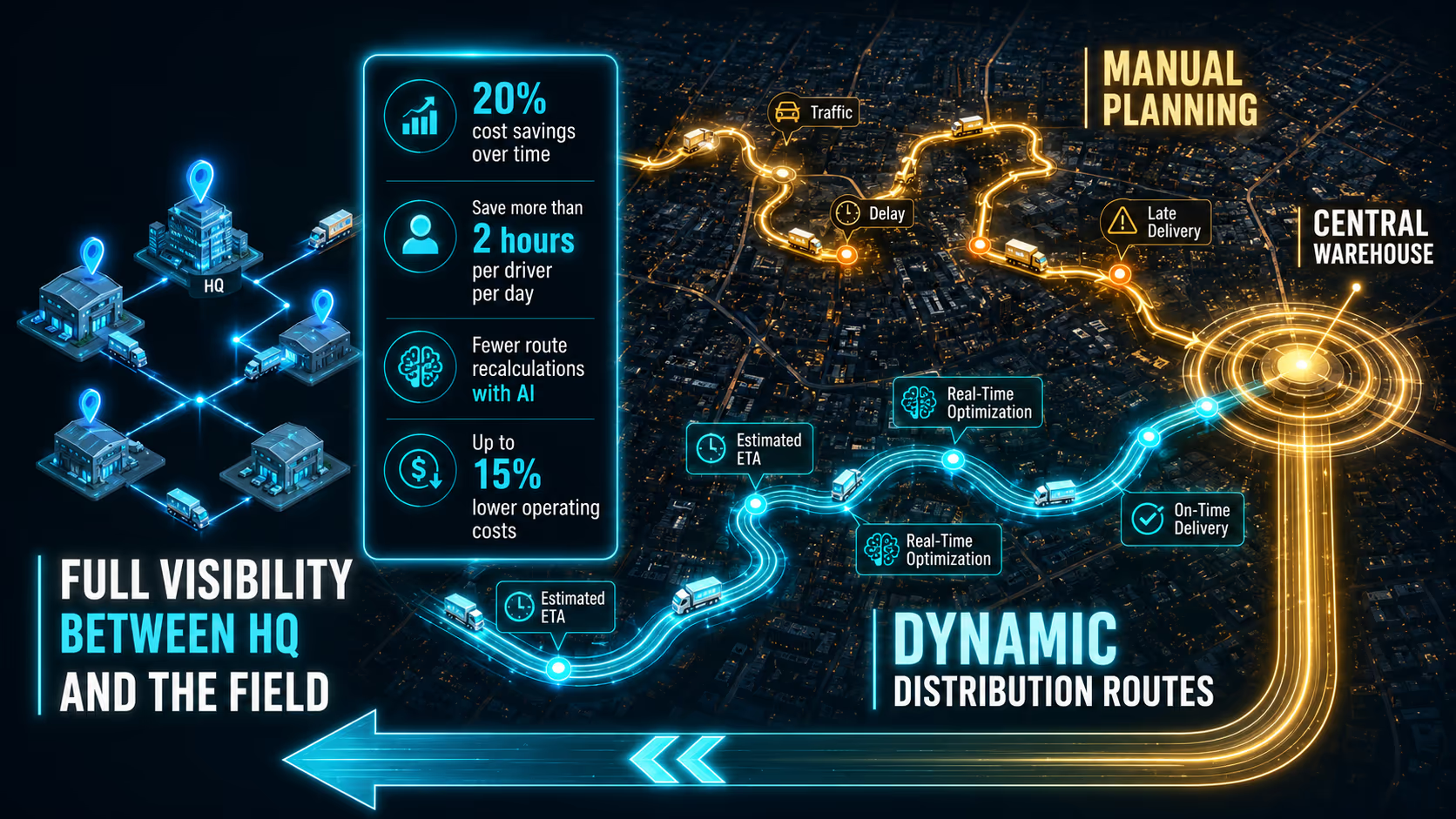
That gap is expensive. According to industry data, 60 to 75 percent of daily planning can be disrupted because of field changes and delays, while 30 to 40 percent of driver time may be lost to unnecessary kilometers, waiting, and poor coordination. This is a systemic failure in the link between headquarters planning and changing field reality, a gap AI systems are designed to close.
| Planning method | Typical operational outcome |
|---|---|
| Manual planning | Slow response to congestion, order changes, and driver constraints |
| Traditional static routing | Better than spreadsheets, but limited in real-time recalculation and multi-stop route management |
| AI-powered TMS | Continuous optimization around time windows, capacity, traffic, and service priorities |
What an Israeli Delivery Day Looks Like
Operations in Israel are complex by nature. Urban deliveries in Tel Aviv, Bnei Brak, Jerusalem, and Haifa involve traffic jams, unloading restrictions, narrow streets, customer receiving windows, and frequent schedule changes across a Sunday-to-Thursday work week.
For a food-products customer I supported, a typical delivery day included a truck leaving a central warehouse for 18 B2B stops. Mid-morning two customers asked to postpone delivery, one order was missing part of the load, and congestion on the Ayalon Highway increased. Before they had a system, the dispatcher called the driver, changed the sequence based on intuition, and updated customers one by one. He once told me the most frustrating moment was when the driver was already heading completely in one direction, headquarters called in a panic about a change, and there was no way to update everyone at once. After moving to an AI-based system, those changes became calculation inputs, and the full route set was rebuilt quickly with updated ETAs. Within the first week after go-live, the number of calls the dispatcher received from drivers asking for updated route guidance dropped noticeably.
The Israeli Clock and Why It Makes Things Harder
A Sunday-to-Thursday work week, concentrated holiday periods, and a business culture where an order can change until the last hour create a significant planning burden for Israeli distributors that does not exist at the same intensity in markets with a more stable work week. Add a shortage of professional drivers, and every hour of manual planning is worth more than the equivalent hour elsewhere.
Why Multiple Systems Make the Problem Worse
Manual planning rarely fails on routing alone. It collapses because information is split across ERP records, warehouse updates, driver phone calls, customer-service notes, and separate fleet tools. Many logistics managers tell me the greatest frustration arises at that moment when the driver in the field is already doing something entirely different, headquarters calls in a panic about a change, and there is no way to update everyone at once. It is also worth remembering the broader economic backdrop: since 2020 warehouse worker wages in the United States have risen by more than 30 percent, and 82 percent of supply-chain managers worldwide report a direct operational impact from tariffs. When labor costs, fuel, and service expectations rise together, every planning failure hits operating profitability directly.
- Manual planning leans heavily on the personal knowledge of a single dispatcher
- Traditional routing struggles with live changes after vehicles leave the terminal
- A TMS becomes far more useful when connected to ERP, mobile apps, and field reporting
What Are the Benefits of AI-Based Distribution Route Optimization
Some organizations report a 5 percent improvement in gross margin, alongside the route-efficiency gains already noted. The central advantage is the ability to respond to changes in real time and maintain stronger control under shifting conditions.
It is also important to say this honestly. The transition is not instant and involves implementation and training for drivers and dispatchers, and sometimes initial resistance from people who have worked another way for years. But the long-term operational return justifies it.
How AI Improves Returns and Operational Efficiency in B2B Distribution
AI improves yield by cutting waste that manual planning treats as inevitable: empty kilometers, poor load sequencing, unnecessary waiting, planner overtime, and missed deliveries that could have been prevented. According to Gartner, 45 percent of companies already use AI-based demand forecasting, and another 43 percent plan to adopt it within two years.
Businesses with an optimized supply chain have costs that are about 15 percent lower and hold less than half the inventory of non-optimized competitors. The meaningful contribution of AI appears when the system manages the full set of operational, logistics, and even financial field processes, rather than treating route optimization as an isolated task.
Which Operational Gains Matter Most in the Field
The largest gains usually appear in four areas. Fuel use drops because routes are shorter and involve less waiting. Workforce utilization improves because planners stop rebuilding schedules manually. On-time performance rises because ETAs reflect current road conditions. Service coordination improves because mobile updates from the field feed back into the planning engine, exactly as happened with the food customer I described above.
- Lower costs through less fuel, less unnecessary mileage, and lower vehicle wear
- Better timing through dynamic assignment of tasks, loads, and driver availability
- Higher service reliability through accurate ETAs and fewer preventable delays
- Capacity growth through more stops or calls per vehicle and technician, without an immediate fleet expansion
From our experience, one insight is discussed less often. Success is not measured only by the percentage of fuel saved, but by how many late delivery runs were avoided, a metric field managers know well but rarely present to leadership.
Why Artificial Intelligence Matters Beyond Routes Alone
A distribution route is usually part of a broader customer process, so the impact of AI extends beyond transportation itself. A delayed truck can disrupt billing, shelf availability, and service calls. Industry research indicates that 80 percent of sales teams using AI reported a positive impact on customer retention, and 72 percent of managers noted a drop in administrative load.
How a TMS Recalculates Routes in Real Time
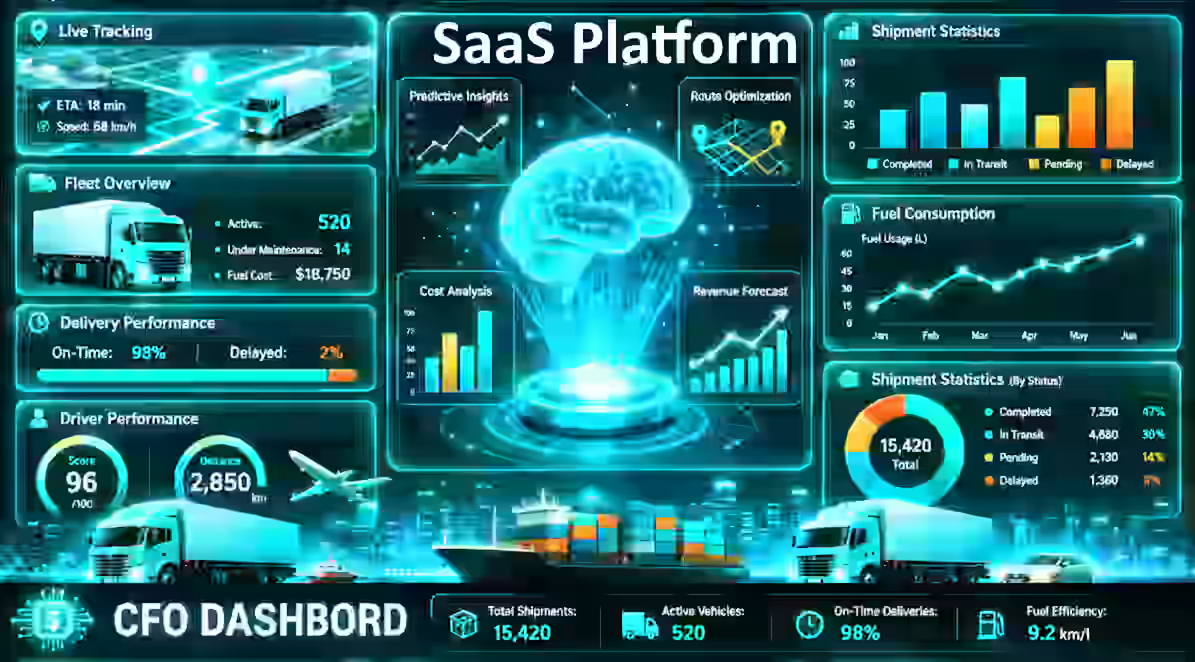
Modern TMS systems recalculate routes in real time by continuously combining live field data with operational rules. The AI inside the system scans traffic, order updates, cancellations, driver availability, vehicle capacity, and service windows, then rebuilds the best workable plan. The goal is simple: reduce delay, avoid unnecessary travel, and keep execution aligned with what is actually happening on the road.
The first time an operations manager sees an entire route change in front of their eyes, without moving a finger, there is a very natural human reaction of distrust. A question I hear often from drivers is, “Who says this new route is really better than the one I would choose myself?” The answer I give is that the system is not trying to replace the driver's judgment; it simply sees dozens of variables at once that no person can hold in their head while driving.
Which Data a TMS Analyzes in Real Time
Route recalculation depends on a constant input stream, not a single morning plan. Typical inputs include traffic congestion, weather, new orders, cancellations, missing loads, customer availability changes, vehicle limits, and driver work rules. In Israeli operations, receiving hours in industrial zones and urban unloading restrictions can change the optimal route even when distance stays the same.
| Live variable | Why a TMS recalculates the route accordingly |
|---|---|
| Traffic | Prevents unnecessary delay and improves ETA accuracy |
| Order changes | Keeps stop sequence and capacity utilization aligned with actual demand |
| Cancellations | Removes wasted travel and frees capacity for other stops |
| Weather | Adjusts route timing and safety assumptions |
| Driver and vehicle limits | Prevents invalid or impractical assignments |
Managing distribution routes?
Leave us a WhatsApp message and we'll get back to you with an initial fit check.
How Enterprise Integration Affects Route Calculation Quality
Real-time TMS performance depends on integration quality. If ERP, warehouse records, driver apps, and customer updates are disconnected, recalculation will be partial and late. The most important lesson we learned from integrations with Israeli ERP systems, whether Priority, SAP, or others, is that even minor integration gaps can cause significant operational disruption. We found that one of the critical steps is ensuring full synchronization of product codes across systems, because a small product-code mismatch can disrupt load calculation for an entire truck.
A driver app that works online and offline sends statuses, proof of delivery, photos, signatures, and exceptions to headquarters. The app should be a full mobile workstation, not only a reporting tool, so field staff receive tasks, run processes, and communicate with headquarters as an integral part of the central system.
The Human Role in the Age of Automated TMS
Artificial intelligence does not manage people. Even the best system needs a team that knows how to work with it. The role of the dispatcher or logistics manager shifts from a planner trying to remember everything, to a supervisor who spots real exceptions that need human judgment and feeds insights back into the organization. The ability to recognize when a customer needs a personal touch, when a driver needs support beyond on-screen instructions, and when it is worth departing from the system's recommendation remains entirely human.
What You Can Do This Week
If you are unsure whether to start exploring the topic, my suggestion is simple. Pick one delivery day this week and map every decision-making failure point that day: every order change, every delay, every unnecessary phone call. Often that map alone is enough to show how much of the day is spent managing exceptions instead of running the business.
The understanding that planning fails without a full real-time picture is exactly what led us at WEBLET to design the platform so everyone, from headquarters to the driver, sees the same picture at the same moment. WEBLET, one of Israel's leading platforms for logistics, distribution, and route optimization management, was built to address the same operational failures I described here, not as a marketing add-on to them.